
Key Takeaways
- Quantum materials are key to advancing next-generation electronics, information technologies, and quantum computers.
- For over 30 years, world-leading X-ray tools and experts at the ALS have helped researchers from all over the world investigate quantum materials such as superconductors, topological insulators, and correlated electron materials.
- The Advanced Light Source Upgrade project will generate brighter beams of X-ray light, allowing researchers to push the boundaries of quantum materials research further by collecting data with far greater detail than has been possible before.
For more than three decades, the Advanced Light Source (ALS), a DOE Office of Science user facility at Lawrence Berkeley National Laboratory (Berkeley Lab), has helped scientists from all over the world advance their understanding of quantum materials - solids whose electrons interact so strongly with each other that entirely new collective behaviors such as superconductivity, exotic magnetism, and other phenomena emerge, defying the predictions of conventional theory.
The ALS is a leading third-generation synchrotron light source that specializes in soft X-ray and UV light instrumentation while providing researchers access to a full spectrum of X-ray light for scientific research. Through the years, powerful tools at the ALS have helped researchers from academia, the national labs, and industry identify and confirm the presence of quantum phenomena, leading to a number of significant advances, including early insights into graphene; the discovery of superconducting topological insulators; the development of a one-atom-thin magnet that could advance next-generation memory devices; new insight into the magnetic properties enabling read/write memory and memory storage devices; and a method for building qubits for quantum computers from 2D metal organic frameworks (MOFs).
As electronics approach the physical and performance limits of traditional silicon-based devices, there is a growing urgency to accelerate the fundamental research of quantum materials with potential for practical applications, from beyond-silicon-based electronics to quantum computing. To prepare for this quantum future, the ALS is undergoing a historic upgrade that will produce more coherent (laser-like) beams of light that are orders of magnitude brighter than today. (Watch this video explainer on coherence to learn more.) This, together with anticipated improvements in detectors, will allow researchers to directly measure defects and observe exotic quantum states in situ as they evolve within a billionth of a second at the nanoscale.
Uncovering the secrets of superconductors
Angle-Resolved Photoemission Spectroscopy (ARPES) instruments at the ALS have been pivotal in advancing scientists' understanding of superconductivity, a quantum mechanical property that allows certain materials to conduct electricity with zero or minimal loss.
ARPES uses bright X-ray light to simultaneously map both the energy and momentum of electrons, revealing the full electronic band structure that governs a material's properties.
"ALS-U is a very important undertaking for the U.S. synchrotron research community. [It] will enable new and exciting experiments that will make a big difference in the kinds of research that we do in the field of quantum materials and beyond." - Riccardo Comin, associate professor of physics at the Massachusetts Institute of Technology
Through the years, ARPES tools housed in MAESTRO, the Microscopic and Electronic STRucture Observatory instrument at the ALS, have played a crucial role in untangling the mechanisms of high-temperature superconductivity, superconducting topological insulators, and other new quantum materials. MAESTRO focuses the X-ray beam to a spot as small as 10 micrometers - about one-tenth the width of a human hair - enabling measurements on tiny samples or specific regions of a material.
In 2022, Riccardo Comin, associate professor of physics at the Massachusetts Institute of Technology, and his team used the MAESTRO ARPES instruments at the ALS to identify and measure the velocities of electrons from which superconductivity emerges in a Kagome metal, an emerging quantum material that could serve as a platform for discovering other quantum materials and potentially lead to a new class of superconductors, new approaches to quantum computing, and other quantum technologies.
"MAESTRO at the Advanced Light Source is one of the leading ARPES tools in the world," Comin said. "It is an important tool for studying quantum materials, because it gives you a snapshot of where the electrons are on an energy spectrum."
The ALS Upgrade will enable X-ray beams focused to less than 25 nanometers - small enough to resolve nanoscale variations in quantum materials that are invisible to current instruments. The ALS is exploring further upgrades down to less than 10 nm, including a new technique called "Ultimate NanoARPES" that will be sensitive to individual defects in quantum materials like superconducting qubits and exotic metals.
"ALS-U is a very important undertaking for the U.S. synchrotron research community. It's a very important development that will enable new and exciting experiments that will make a big difference in the kinds of research that we do in the field of quantum materials and beyond," Comin added.
Transforming quantum spin into next-gen spintronic devices
ARPES techniques at the ALS have also helped researchers unveil quantum phenomena that could enable next-generation spin electronics (spintronics), which promise to be smaller, faster, and more robust than today's devices.
In a recent advance, Ming Yi, an associate professor of physics and astronomy at Rice University, used spin-resolved ARPES techniques at the ALS to measure the energy, momentum, and spin of electrons in crystal compounds made of indium, tantalum, and sulfur (InxTaS2). The results demonstrated a way to regulate electrons of opposite spins not only along the surface but also within the 3D structure of the crystal. Controlling the movement of these electrons could produce desirable properties that may advance future applications in electronics and spintronics. The work also demonstrated a quantum theory predicting a material with superconducting properties that could enhance the computation speed of a quantum computer.
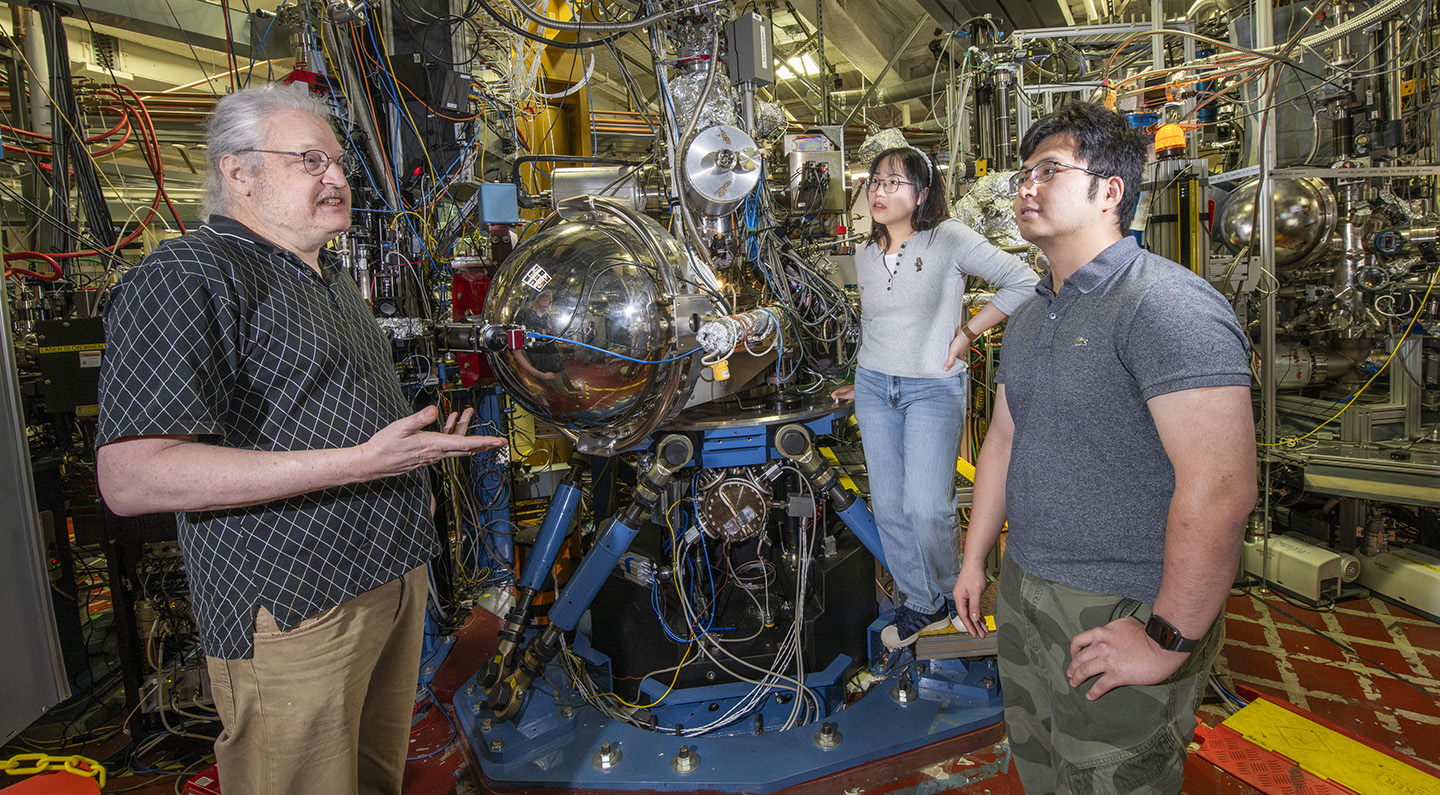
Spin-resolved ARPES employs 3D detectors to characterize the direction of electron spin. The ALS Upgrade will significantly improve the technique's energy resolution, flux (the rate of X-rays incident on a sample), and stability.
"The ALS Upgrade will allow us to probe smaller length scales of electron coherence and emergent electronic phases that are not accessible with the tools we have now," Yi said.
Developing qubits
Defects in qubits can lead to decoherence and processing errors in quantum computing, The effect of these impurities is difficult to assess because researchers have limited access to tools that can directly measure quantum coherence - the delicate state where electrons maintain their quantum phase relationships across a material.
The ALS Upgrade Project (ALS-U) is poised to help researchers who rely on the ALS to demonstrate new techniques for synthesizing quantum materials with enhanced control at the nanoscale.
"The ALS Upgrade's brighter, more coherent light is critical to seeing how a particular defect spoils coherence in a qubit. It will also allow us to get to smaller length scales and shape how a quantum material works," said Eli Rotenberg, a senior scientist who leads the ARPES program at the ALS.
Probing quantum phenomena with coherent X-ray scattering
Electrons are negatively charged particles imbued with an intrinsic property called spin that somehow creates tiny magnetic fields. Understanding how electrons behave collectively can bring new insight into the evolution of quantum phases such as superconductivity and magnetism.
In addition to ARPES techniques, the ALS is a leader in coherent soft X-ray scattering, an essential tool for measuring how electrons and their spins are heterogeneously arranged in a material.
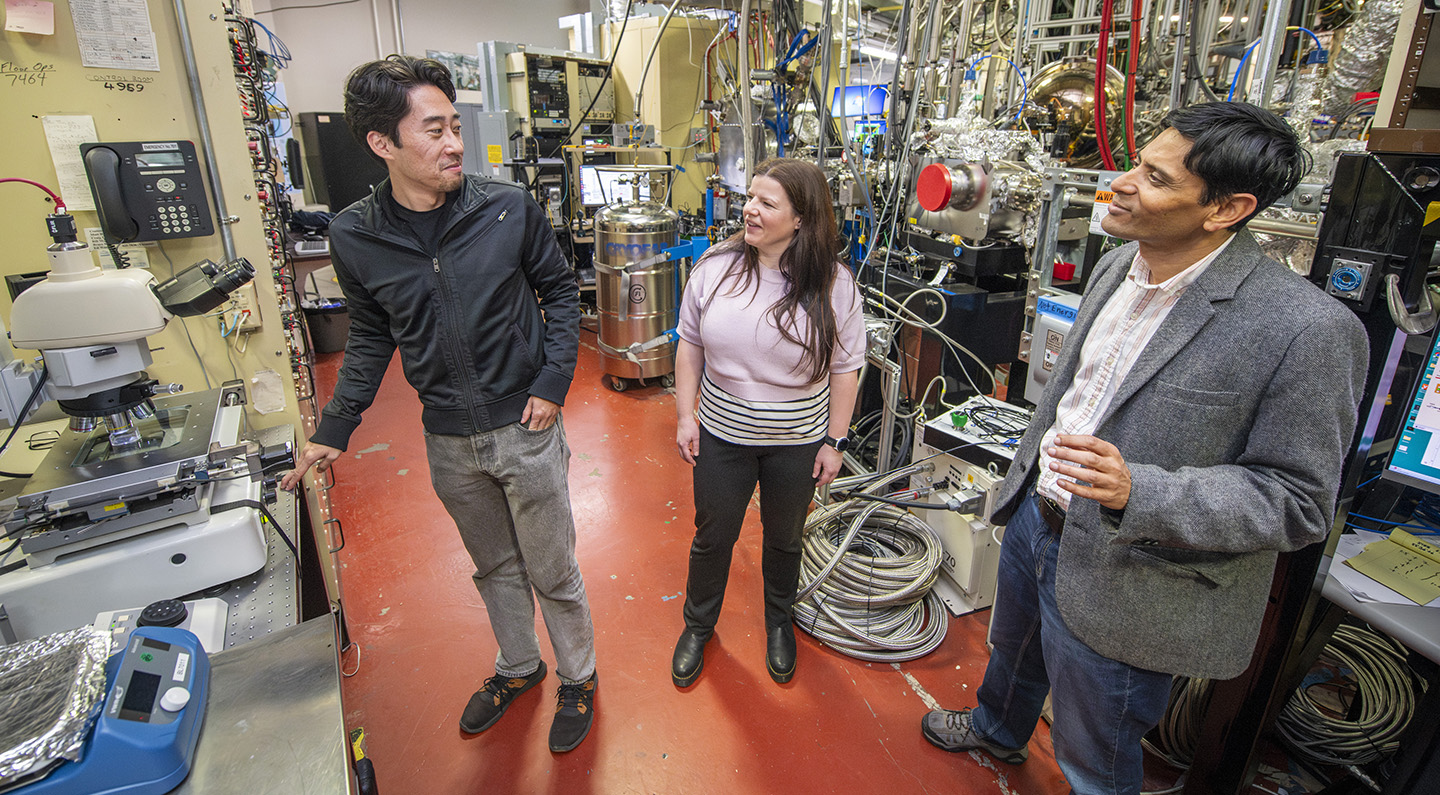
Coherent scattering at the ALS is currently supported by the COSMIC (Coherent Scattering and Microscopy) instrument, but after the upgrade, the technique will move to a planned new instrument called FLEXON (FLuctuation and EXcitation of Orders in the Nanoscale).
FLEXON will have two new capabilities: X-ray photon correlation spectroscopy (XPCS), a technique for measuring nanosecond fluctuations in charge and spin in quantum materials; and a coherent X-ray reflection microscope that images the electronic and magnetic features of a material at the nanoscale.
The groundbreaking new microscope - which is being developed by ALS research scientist and project lead Sophie Morley in collaboration with ALS senior staff scientist Sujoy Roy and Comin - will allow researchers to look at nanoscale charge and spin patterns in a wider variety of materials, from thin 2D materials to thicker single crystals. Their work is supported by Berkeley Lab's Laboratory Directed Research and Development program and the Department of Energy's Office of Science.
"This new technique will transform how we look at quantum materials," said Comin.
Advancing neuromorphic computing with XPCS
FLEXON's XPCS instrument will enable nanosecond fluctuation studies that will help Alex Frañó, associate professor of physics at UC San Diego, push the boundaries of an emerging technology called neuromorphic computing. By mimicking the neural networks of the brain, neuromorphic computing systems may have the potential to advance quantum computers and AI technologies that process information more efficiently and with less energy than current methods.
"The brain is an instrument that can do remarkable computation with very little energy. Neuromorphic computing is interested in how we can harness electronic properties in materials to replicate aspects of the brain's neural system," Frañó explained.
The new XPCS instrument will allow Frañó to explore how correlated electrons communicate across very small distances at the nanometer scale and track the dynamics of these events within nanoseconds.
"Advancing my work in neuromorphic computing will 100% rely on the ALS Upgrade. The brighter coherence will allow us to probe the ordered patterns of electrons in a transformative way and uncover quantum mechanical phenomena that would otherwise be impossible to detect," Frañó said.


