
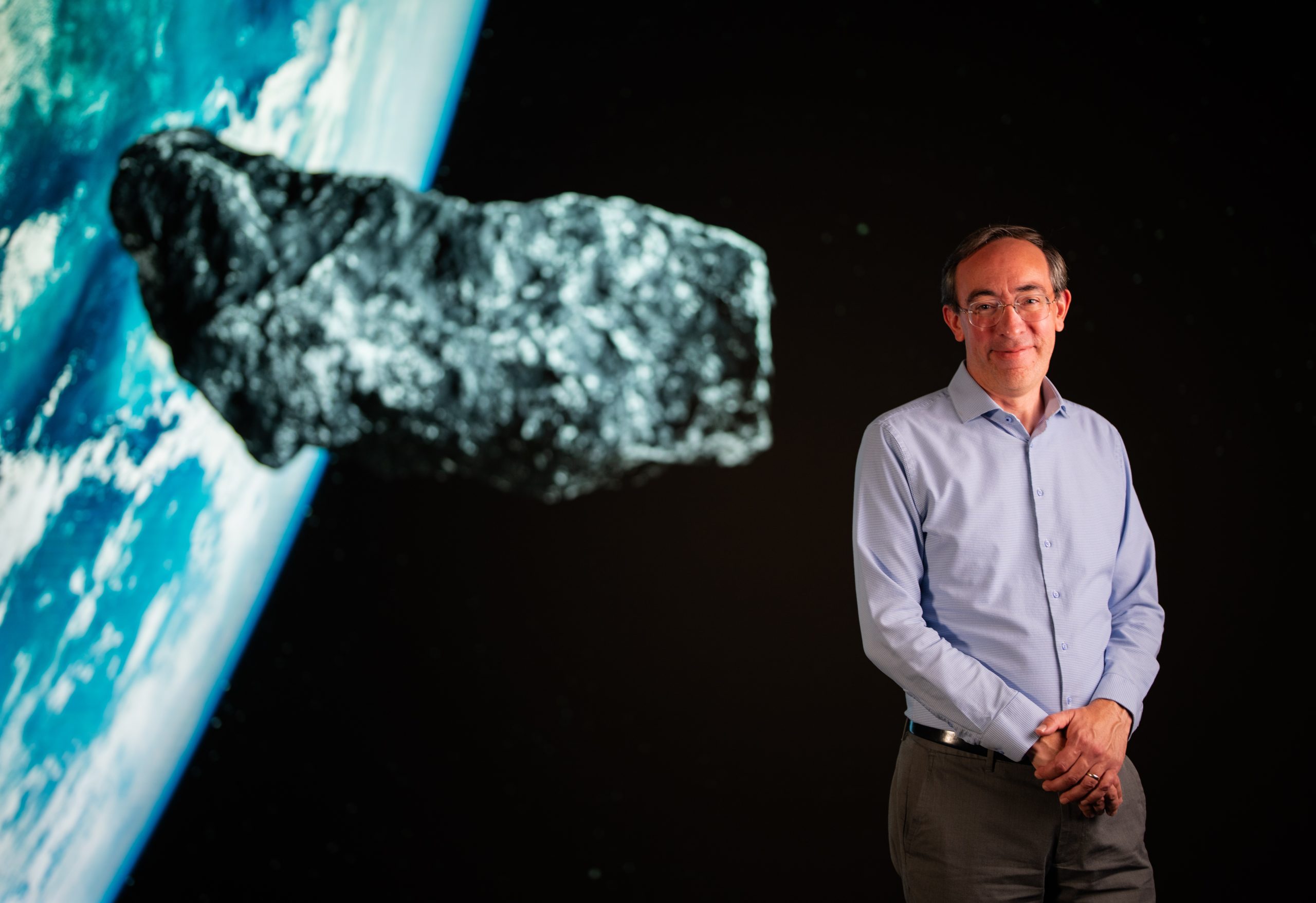
If a dangerous asteroid were headed toward Earth, one defense could be a nuclear detonation to blast one side with X-rays and nudge it off course.
But new simulations suggest that for a lumpy, irregular asteroid, exactly where those X-rays hit could make a huge difference.
In a study published in Icarus, researchers found that irradiating different sides of the same simulated asteroid changed how much momentum the blast imparted and how much spin it induced. In one case, the deflection velocity - the change in its linear speed after the simulated X-ray burst - was 3.9 millimeters per second from one angle, but just 0.8 millimeters per second from another: a nearly fivefold difference.
"We expected aim to matter," said Nathan Moore, a physicist at Sandia National Laboratories who led the research. "What surprised us was how much."
For a different asteroid, the change in its rotational speed after deflection - how fast it spun - varied by a factor of 17.
The findings underscore that in a real attempt to use a nuclear burst to deflect an asteroid, knowing the object's shape and choosing the right side to target could be critical.
The research was funded by Sandia's Laboratory Directed Research and Development program.
No more spheres
To get their data, Moore and his colleagues created the most accurate asteroid deflection model to date. Most previous models simplified the extremely complicated problem by choosing between realistic asteroid shapes and high-fidelity math. Moore's team has created a model that includes both.
The new simulations offer the most detailed look yet at the asteroid deflection problem.
"Our new algorithm is over 1,600 times faster, which was critical to this breakthrough," Moore said. "With the old models, computers just couldn't handle it."
Moore has been studying the issue of accurate modeling since an experiment at Sandia's Z machine showed, for the first time, that X-rays could deflect a small piece of asteroid material.
"I started wondering how to scale up the calculation to more accurately predict deflection of a full-scale asteroid."
Most researchers modeled asteroids as spheres, he said. It made the math easier. But spherical asteroids do not exist.
"You can make estimates that way, but asteroids come in all kinds of odd, lumpy shapes," he said. "That's when I latched onto some work one of my colleagues was doing related to outgassing of objects in space. I think we had an aha moment when we realized we could do this. No more spheres. We would be able to model deflection for any asteroid."
He borrowed high-fidelity codes used at Sandia for a variety of problems and combined them to work on asteroids.
"The ALEGRA code is normally used to model fast, high-energy experiments, like magnetically imploding wires on the Z machine, while SPARTA, a direct simulation Monte Carlo code, is usually used to model comparatively weak, slowly evolving forces, like the drag on a satellite from the solar wind," Moore explained.
"The key innovation here was figuring out how to combine the two simulation approaches."
Simulations for a safer future
The simulations let researchers model an asteroid based on high-resolution 3D imagery from spacecraft flybys, then simulate effects from an X-ray burst while tailoring the size and distance of the explosion, as well as which side gets irradiated.
The code generates a heat map showing how much of each part of the surface gets vaporized. From that, the program calculates how hard the asteroid would get pushed, how fast it would spin and how much the surface might break apart.
That last part is important because the goal would be to push the asteroid, not smash it into smaller but potentially still deadly pieces.
"Right now, our computer model only considers breakup of rocks on the surface. We can't predict breakup of the entire asteroid body accurately yet," Moore said.
To do so will take more research and investment in even better modeling tools. An X-ray blast would have many effects on an asteroid, and those effects might interact with each other. That makes a comprehensive calculation of what will really happen in a planetary defense situation incredibly complicated, but it's exactly what scientists like Moore are striving for.
While that remains an endeavor for the future, these latest results have major implications if humanity ever needs to deflect an asteroid.
"Our study shows how important it is to aim carefully," Moore said. "Pick the right side and you win. Guess wrong and it could be a bad day."
His team's work provides a tool to plan and maximize the chances of success. In theory, one could upload information about the asteroid, calculate the optimum explosive strength, distance and direction of the blast to save Earth and then go do it.
There are limitations. The simulation needs fairly accurate data on the asteroid's shape from all sides, and humans might not have time to get that information. Positioning an explosive at the ideal distance from the correct side of an asteroid as it silently screams through space also would be tricky.
Still, this research reduces guesswork for avoiding doomsday.
And that, Moore said, is very encouraging.


