
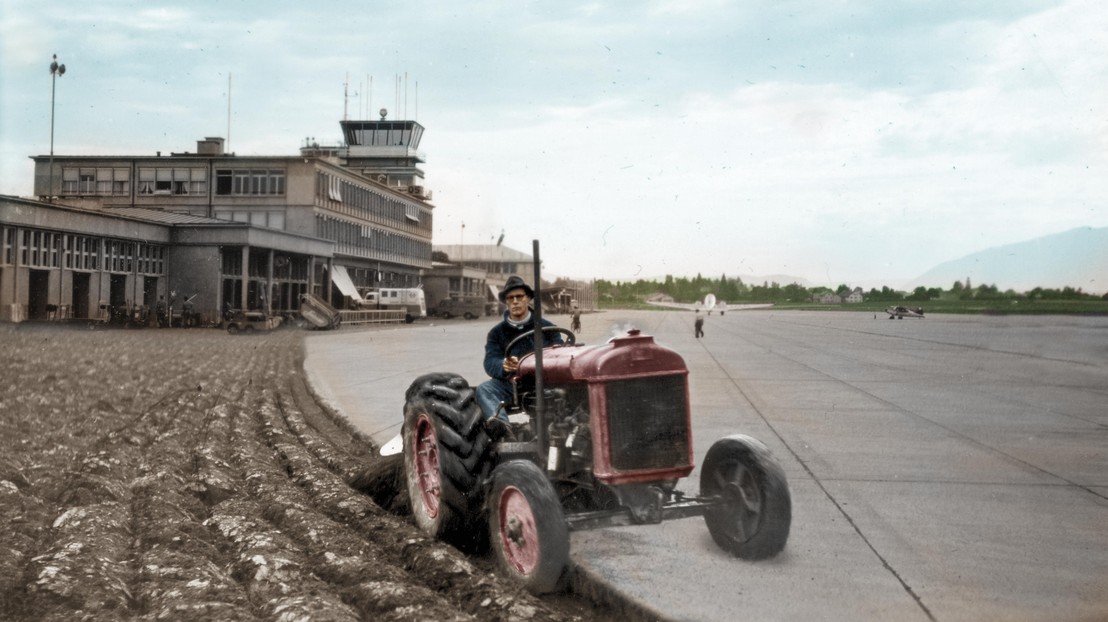
© Plonk & Replonk-Bébert
EPFL social transitions researcher Sascha Nick puts forward bold proposals to solve our mobility problems.
Sascha Nick is a scientist at EPFL's Laboratory of Environmental and Urban Economics. Drawing on his studies in mathematics, economics and physics, he takes a systems approach to analyzing major societal transitions. A frequent media guest, Nick likes to put forth bold and innovative ideas - at the risk of ruffling some feathers.
You examine societies from a systems perspective. How do you view issues related to mobility?
The first thing we need to realize is that mobility isn't a fundamental human need like food or protection. Mobility is what's called a satisfier - a means of satisfying those needs. That said, it plays a key role in shaping human activity and often reveals problems within society. We tend to consider mobility issues as stand-alone problems, but they're often symptoms of something else.
Symptoms of what, for example?
If someone needing to see a doctor has to wait a long time for a bus and make a lengthy trip, the problem might not be a lack of buses, but rather poor availability of health care. Why isn't there a competent doctor closer and easier to get to from where the person lives? When cities experience traffic congestion and excessively long travel times, the problem doesn't necessarily lie with public transport - it's a sign that something else is wrong.
In a recent interview for Swiss newspaper Le Temps, you said that every Swiss person travels an average of 50 kilometers per day, excluding vacations, and most of that is by car.
Yes. That's a lot - on the order of 15,000 km per year. We could slash that to 3,000 by rethinking how our activities are distributed across a given area. Outside of vacation, when we travel, we generally move from one building to another: from the home to the office, school, doctor's office, services, leisure sites, and so on. If such essential services are located far from one another, then travel becomes complicated. But if they're all nearby, then the commuting distances fall dramatically.
Is that the idea behind the 15-minute city?
We think the goal should actually be an eight-minute neighborhood. It's interesting to note that the average amount of time people spend traveling each day is pretty much the same across all societies and time periods - around 60 minutes. That's what's known as Marchetti's constant: people tend to naturally adjust their lives in order to spend roughly one hour per day commuting. If we shorten distances within neighborhoods, then it follows that people would make shorter yet more frequent trips, roughly six to eight each day. That would increase the amount of social interaction, improve residents' well-being and lower the environmental impact.
So how can cities be better planned?
There are a few examples we can look to. For instance, the Aspern Seestadt neighborhood in Vienna shows what can result from well-thought-out urban planning. The city first invested in a subway line that links the neighborhood directly to downtown, and then built up the area step by step, one quadrant at a time, around a lake. Each quadrant is designed to operate as a complete whole with housing, jobs, services and more. This has created a series of neighborhood centers that reduce the need for longer journeys. It's not perfect, but it shows how taking a holistic approach to transport, city services and the stages of construction can substantially reduce travel without compromising on well-being.
history has shown that societies, after trying all the bad ideas, eventually turn to the good ones and are successful in changing.
What about existing cities - how can they be adapted to fit this model?
We recently carried out a study in Confignon, a municipality near Geneva with an accessibility score for shops and other services that's near the Swiss average of around 40%. The study revealed that it's neither realistic nor desirable to connect every corner of a given region. There simply aren't enough people in sparsely populated suburban areas to justify daily services. Instead, we should aim to build up certain districts by grouping together housing and essential services. At Confignon, that would mean creating four neighborhood centers that are well-connected to each other and gradually abandoning some suburban areas. With this approach, almost all of the built-up surface would be recovered and we could considerably improve how the neighborhoods operate.
It sounds like all this will also affect how we occupy our spaces.
Many of today's buildings are under-used. Most households now consist of one or two people, yet homes are still designed for families with children. That means a lot of space, materials and energy are being wasted. One option could be to reduce the amount of personal living space occupants have while increasing the size of common areas such as kitchens, living rooms and work spaces, and fitting them out better. This would be particularly beneficial for children and the elderly. Children would have a safer and more diverse social environment, while the elderly, as they gradually lose autonomy, would be able to live at home longer, with other people around, rather than move to a retirement home.
So we wouldn't need to construct any more new buildings?
It's true that the idea is to make better use of existing buildings instead of constructing new ones. Most buildings can be renovated and laid out differently without taking down their load-bearing structures. And the workers who would have been assigned to new home builds could be redirected to renovating, insulating and upgrading existing buildings. This would go a long way towards speeding up the real-estate transition and have a major impact on emissions and costs while improving our well-being.
The changes you suggest imply we need to completely reorganize our society. That could scare a lot of people.
That's possible. But culture is something that changes constantly, and sometimes very quickly. Consumerism took hold in barely a decade back in the 1950s. All the components I've suggested already exist: shared spaces, cooperatives, mixed-use neighborhoods and local services. What's missing is bringing them together systematically into every urban planning project.
You seem fairly optimistic, notwithstanding the urgent need for change.
That's partly due to my nature - it's just how I am. But it's also because history has shown that societies, after trying all the bad ideas, eventually turn to the good ones and are successful in changing. If we do nothing, we'll reach the breaking point in 20 to 40 years. The transformation that's needed won't occur unless we pool our efforts. We've got to work together, go out and speak with people and engage the media, our educational system and our entire community. All that also keeps me motivated!
You've also examined air travel.
The airline industry is one where people believe technology will solve all our problems. In my research, I started with the simple task of thinking seriously about the target that the industry set for itself: reaching net zero by 2050. The emissions reductions enabled by technology, while essential, won't be enough. So far, airline companies have been able to improve their fuel efficiency by around 1% per year. By improving their engines, raising flight occupancy rates and optimizing traffic, airlines could achieve a 25% additional improvement by 2050. But to meet the net-zero target, they'll need to cut emissions by around 90%.
What ideas are you exploring?
We recommend viewing air travel as a global system with a total number of passenger-kilometers. Every year the authorities would set a cap for flights on this basis, consistent with a net zero trajectory, and the cap would decline with each passing year. Airline companies could purchase the passenger-kilometers they need in an auction. As the annual cap declines, the supply of passenger-kilometers would shrink and their price would go up, prompting airlines to operate fewer flights. And airlines would be required to participate in this system if they want to access the major international airports. That means any airline companies incorporated in countries that haven't signed up to the system won't last long, since they wouldn't be able to fly to the main hubs. The revenue from this system would be invested in restoring ecosystems that naturally remove carbon from the air, like rainy and coastal environments - we can't afford to wait for artificial carbon-capture technology to mature. The combination of fewer flights and restored ecosystems will eventually offset the residual emissions and enable the global airline industry to reach net zero.


