
Students learned tools for facilitating constructive dialogue and fostering connections with those with different perspectives

Participants practicing civil dialogue while sharing opposing viewpoints (Photo courtesy of Edina Oestreicher).
In a time when political polarization seems inescapable, especially online, understanding how to create civil dialogue is more crucial than ever. Students from an array of backgrounds came together at UConn Storrs on March 27 to do just that during the "Let's Talk: Navigating Hard Conversations on Campus" retreat sponsored by UConn Hillel, the Gladstein Family Human Rights Institute, and the Blue Square Alliance Against Hate.
Edina Oestreicher, the executive director of UConn Hillel, said that she was invited to apply for a grant to create a "Campus Connections" initiative where student leaders gain the transferable skills of actively listening, asking meaningful questions, and practicing thoughtful communication with other leaders. With the grant, UConn Hillel partnered with the Gladstein Family Human Rights Institute to host an interactive workshop facilitated by faculty affiliated with the "Democracy and Dialogues Initiative."
The goal is for others to deepen their understanding of each other, she said: "Speak first to understand before being understood."
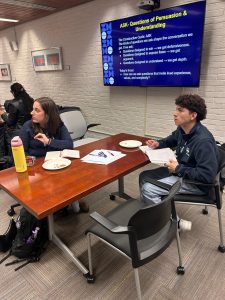
Prior to beginning the retreat, table rules were introduced. Speakers had to be honest, use "I" statements, criticize the idea and not the person, and maintain confidentiality - "Stories stay; Lessons leave."
In small groups of four or five, each participant had one minute to reflect on the prompted questions, followed by each participant allotted exactly two minutes to tell a personal story of how their background or experiences affected their ideas surrounding race, racism, and ethnic groups.
As an extension to the first exercise, multiple case studies were presented: "A Latina speaks English with an accent. She feels that her coworkers don't take her seriously"; "Leaders of a multi-cultural annual fair are upset. They invited a community member of Sioux descent to perform a Native ceremony"; and others. After reading 10 distinct scenarios, each participant again had two minutes to share which statements resonated with them and why. As the speaker talked, the other participants had to listen without responding or reacting.
Then a brief whole-group discussion occurred, unpacking the 3 "D's": debate, deliberation, and dialogue, with students examining the differences between each one.
Blending interactive exercises and lecture, Nana Amos, director of Community Outreach & Engagement at the Gladstein Family Human Rights Institute and co-director of the "Democracy and Dialogues Initiative," presented on the neurobiological response humans have when conflict arises.
Amos said that when our perspective is challenged, our brains perceive that we are under threat, causing us to default to survival mode of either "fight," "flight," "freeze," or "fawn."
A cycle of defensive response begins when someone is "triggered" by something another person said, prompting that person to become "vigilant" and begin "attacking" the other person's statement. The cycle continues, and on campus, this mode of interpersonal interaction causes individuals to experience sleeplessness, anxiety, rumination, avoidance, and depression.
Constructive response is the curative measure to feelings and symptoms of threat we experience when there is disagreement, Amos said. This consists of listening to others to understand their values and emotions, reflecting on what the other person said, responding to also be understood, and asking questions for further clarification.
To model this constructive response, students were assigned tasks: one participant had two minutes to share a personal obstacle they overcame. The remaining participants were assigned to either listen to understand the speaker's actions, their emotions, or their values from the story told. Each student had equal time to share their experience and analyze the next speaker's emotions, values, or actions.
Following the conclusion of the full-spectrum listening exercise, navigating complaints were discussed. Participants were challenged to reframe complaints as people expressing hope. An example given was if there is a complaint that campus is not inclusive enough, we should think about the person making the complaint as expressing hope to see a campus that fosters a sense of belonging for the student body.
Combining the lessons and practice of listening and reframing one's mindset, participants were taught how to become facilitators for productive interaction.
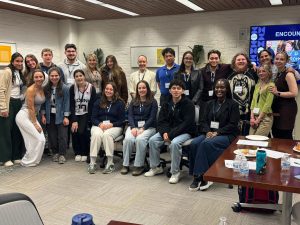
Impartiality was emphasized, with a facilitator encouraging everyone to provide their input, and with the end goal of participants leaving the discussion understanding each other's viewpoints.
Students were able to model a peer-facilitated dialogue. One volunteer chose to play the facilitator, and the other four volunteers were randomly assigned to act as either a normal participant, a dominating participant, or a problematic participant, to see how the process plays out in real-time and what a response from the facilitator can look like.
Brianni Cabrera'26 (CLAS) came to the retreat with an interest in international diplomacy and working with corporations on a global scale. Her goal was to learn how to handle conflict, recognizing that everyone needs improvement in conflict resolution.
"Open dialogue is needed in today's society to combat conflict in general. Without insight, you're lacking connection to others," she said.
Cabrera volunteered to act as a facilitator and maintain dialogue as a problematic participant was tasked to interrupt other student volunteers and refute their claims. Her main takeaway was learning "how to combat closed-minded individuals who are still part of the conversation without diminishing their opinion."
History Professor Brendan Kane, co-director of the "Democracy & Dialogues" program, started thinking about creating a new dialogue model for respectful communication back in 2016. Kane wanted to engage scholars in meaningful and dynamic ways with community members, emphasizing UConn's mission as a public university. Simultaneously, witnessing universities trying to implement spaces for dialogue after widespread incidents of racism occurred across campuses nationwide, Kane wanted to create a unique process to build strong and resilient communities.
The "Democracy and Dialogues Initiative" is part of Dodd Human Rights Impact Programs. Kane and colleagues in the initiative often collaborate with high schools, university departments, and community organizations to either provide dialogue training, consulting to help create spaces for dialogue, or facilitate content-specific discussion with subject matter experts in person to answer any newly raised questions participants have while they interact. Kane credits Essential Partners and Everyday Democracy for helping to create the initiative.
"It was a way for us to feel that we are in service to the community," he said.


